
In a sentence — triage fast with a value-versus-effort quadrant, or run the full weighted model when the stakes and the competing claims are higher.
Not every prioritisation call deserves the same amount of process. This instrument gives you both ends of that spectrum in one file — a same-session quadrant for a fast first pass, and a fully weighted, criteria-based model for the portfolio conversation with real disagreement in the room. Value should reflect real strategic contribution — a constraint removed, a risk closed, a genuine cost or revenue impact — not how loudly a sponsor wants it; Effort should reflect genuine delivery effort, not enthusiasm to get started.
The two tiers are designed to be used together, not as alternatives: run the quadrant first to triage quickly, then bring the handful of genuinely contested initiatives into the weighted model, where the working can actually be shown. The worked example includes a case where the two views genuinely disagree on the same initiative once complexity is weighted honestly — seeing why is worth the five minutes it takes.
WHY THIS HELPS
Benefit and complexity are never collapsed into one score. It's tempting to net everything down to a single number; keeping the two axes separate is what lets a mandatory, high-complexity initiative stay visible as mandatory, instead of disappearing because its net score looks unfavourable.
READING THE TWO VIEWS TOGETHER
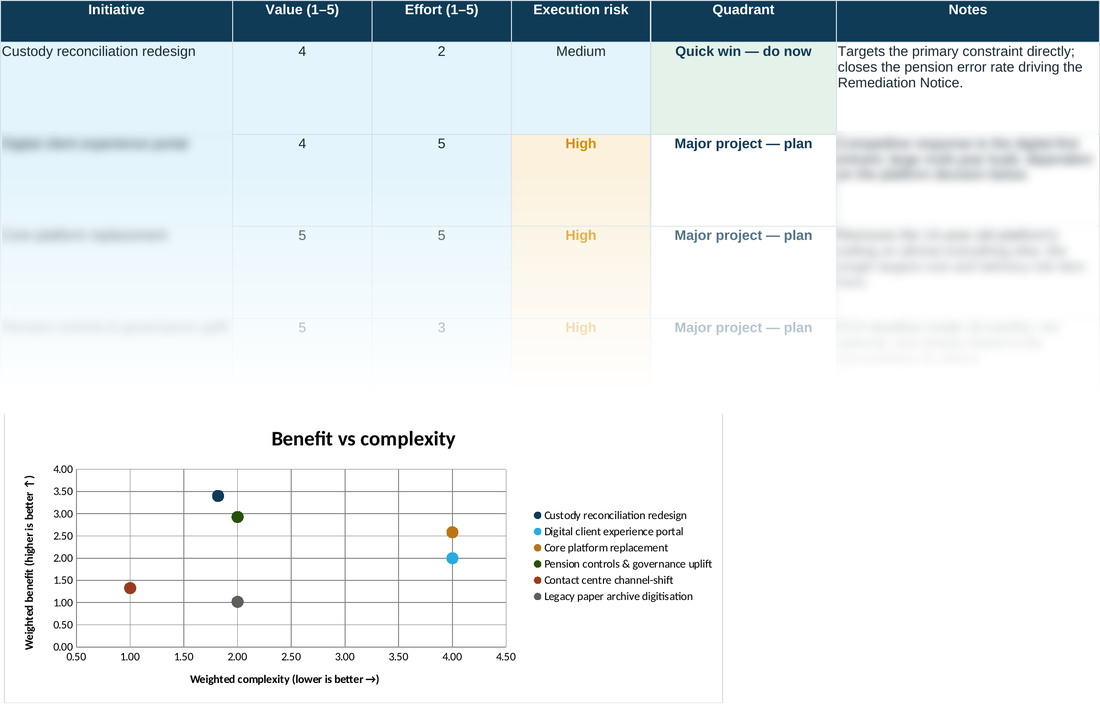
Weighted Benefit and weighted Complexity are each a weight-adjusted average, not a sum — they land back on the same 0–4 scale you scored against, so a weighted Benefit of 3.2 reads directly against the same anchor text you'd use to score an individual criterion. Net priority is simply Benefit minus Complexity, so it can go negative — that's not a bug, it's the model telling you complexity outweighs benefit once everything is weighted honestly. The worked example makes the two-tier point concretely: the quick quadrant buckets a platform-replacement initiative and a controls-uplift initiative together as ‘Major project’, because both score Value 5 and Effort 3–5. The weighted model tells a sharper story — the controls uplift ranks 2nd of six by Net priority, while the platform replacement ranks last, because its weighted Complexity (4.0, the maximum possible) outweighs its Benefit once cost, delivery risk and resourcing are scored honestly rather than assumed. The quadrant's four categories genuinely can't show that distinction; that's precisely the gap the weighted model exists to close.
PM · Prioritisation Matrix — the blank tool
Both tiers, ready to complete: the quick quadrant and the full weighted model.
Worked example
Both tiers completed end to end against six Meridian Wealth Management candidate initiatives — including the case where the two tiers disagree.
A quick walkthrough of the sheet:
Need the full method, not just one step?
All eleven instruments — D1 through D10 and the Prioritisation Matrix — at a discount against buying them separately.